

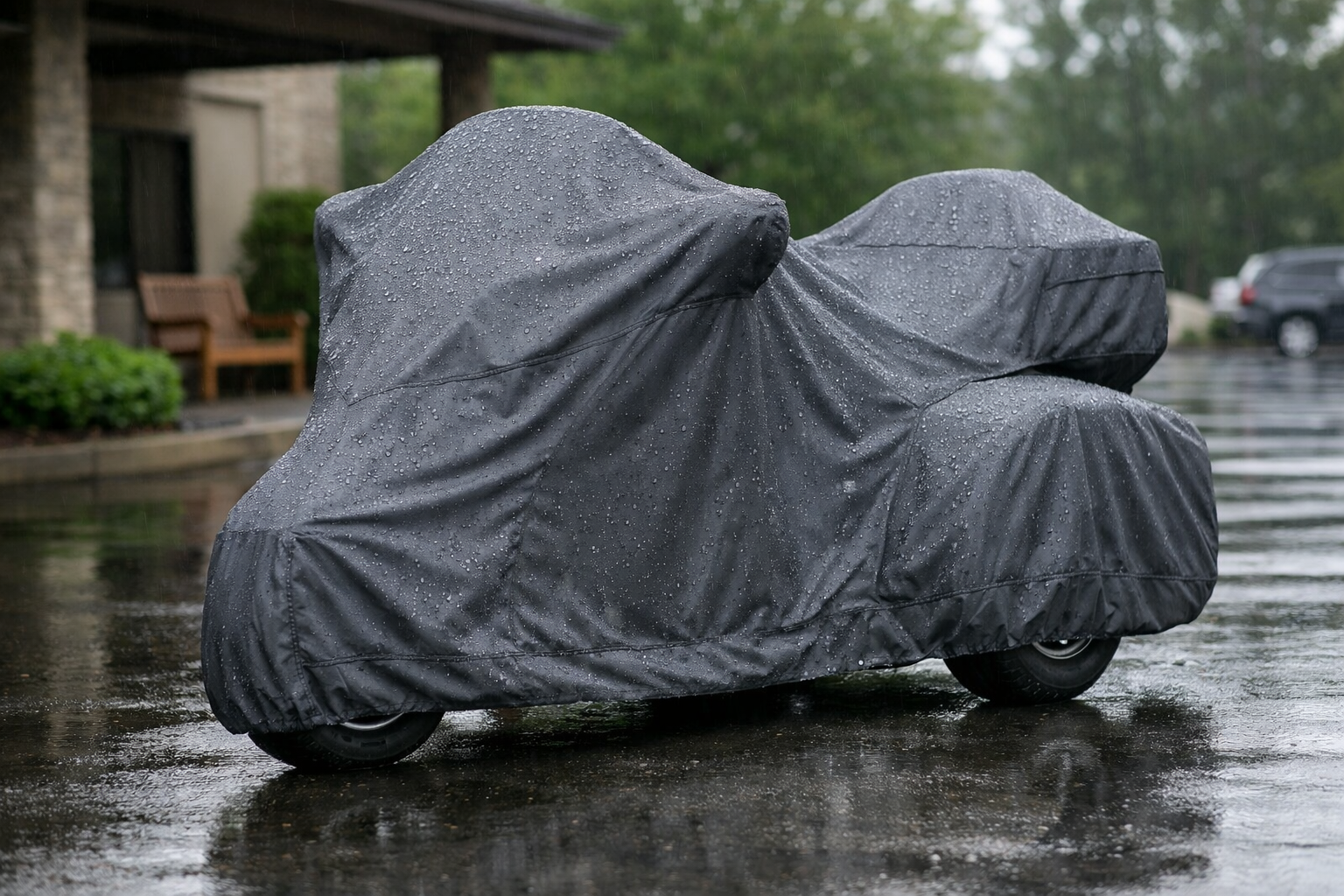
Touring bikes and trikes are designed to devour miles, yet when off, weather, dust, sun, and dirt on the road can silently wear them out. You probably have already guessed the truth, had you ever gone back to your machine, as the storm had passed, and found water in joints, corrosion beginning on the fasteners, or the seat damp when a week later, and you already realize that the ride is but half the tale. The other section is coverage between rides and that is where ShinyWing, all weather motorcycle and trike covers will find its place in a serious touring configuration.
An All-Weather cover is not something to be taken lightly by most riders.
A cover is not that simple a rain jacket of your bike. It is a resistance to UV fading, dust abrasion, bird droppings, tree sap and salty air as well as those little moisture cycles that cause surface oxidation with time. Bikes also gather airborne dust and humidity even in a garage, particularly along coastal or during times of monsoon seasons.
The necessity is even greater among the owners of trike. The greater the bodywork, the greater the number of surfaces to cover, the number of seams in which water can rest, and the number of places where sun can cause the paint to gray out. The correct cover will help in minimizing day to day wear and make your motorcycle appear kept rather than surviving.
What Makes a Real All-Weather Motorcycle and Trike Cover
Most of the so-called waterproof covers do not actually suit the touring conditions. Cover: The optimal cover is one that is protective and functional since you are going to use it frequently.
Waterproof vs Water-Resistant: Understand the Difference
Fabrics that are water resistant may be used during light rainy conditions but during heavy rain or during a storm in the night the water can be forced to move through the seams and sewing. A waterproof cover must have a waterproof outer covering and strengthened seams, preferably sealed or taped where exposed to the most.
Breathability
The following is a bitter experience to many riders at one point: a completely waterproof cover that cannot allow breathing can be trapped by condensation. It is the moisture which is trapped and it is the cause of corrosion of bolts, haze of chrome, and smell of mildew on seats. A good cover ought to be in such a manner that moisture vapor can escape out but at the same time, it shut out rain. Consider it a touring jacket: protection and ventilation.
UV Resistance
Sun damage is slow but brutal. UV rays are used to fade paint, dull plastics and crack rubber trim. Unless you store your bike indoors on a daily basis, which is rather uncommon, UV protection is not a luxury. Seek out materials that are UV rated and a lighter exterior color which reflects heat.
Fit and Coverage: The Touring Bike and Trike Reality
A loosely fitting cover is one that you will ultimately stop using. Touring motorcycles are tall, wide and may be fitted with luggage racks, antennas, backrests or top boxes. Trikes make it even broader and more complicated.
Measure Like You Mean It
Do not guess. Take total length and height, and take into consideration the widest point, particularly in trikes. The cover must not be stretched around mirrors or acute lines. In the event it is too tight the wind will loosen it and seams will strangle.
Although A has three pockets and B only one, the pockets of A are mirrors whereas those of B are windproof.
Mirror pockets are important since mirrors are usually the location where a cover collapses. Shaped fit also minimizes flapping and it is flapping that leads to micro scratching in the long run. Also seek safe tying as elastic hem, removable straps, belly strap which keeps the cover in place during windy weather.
Materials and Construction, The Quality Appears
Should you require a blanket that can be worn over several seasons, then construction is important even more than cloth.
Multi-Layer Fabrics Compared to Thin Shell Covers
Thin covers are convenient, although they tend to offer little in terms of durability and protection. Multi-layer designs incorporate abrasion, enhanced rain, and heat protection. Multi-layer would be worth it should you park outside most of the time.
Inner Lining Is to Be Paint-Safe
A cover ought not to resemble a sandpaper. A gentler interior finish minimizes the chances of scuff, particularly on fairings and smooth paint. This is more so when you leave your bike in places that are close to traffic, construction dust or sand.
Exhaust Areas That Are Heat Tolerant
Riders tend to keep the bike covered quite soon after arrival as is the case with tours. A cover that melts in areas where exhausts or mufflers are placed will not last long. Although there is a cover that says it is heat resistant, it is a good idea to allow the bike to cool down then cover the bike, yet the panels that are heat tolerant provide a buffer of safety.
Everyday Practicality: Small Things That Matter a Lot
A cover might be good, but when it is irritating, then one will not use it always.
Easy On Easy Off Storage Design Was Created to Provide Users With the Simplest Gearing and a Feedback Mechanism That Supports Smooth Movement of Objects In and Out of the Cabinet
Compression bag or built in storage pouch is not a luxury. It is the difference between riding your bike every day and not doing it because it is inconvenient to carry a packet. Personally, I have discovered that the best cover is the one you will actually put on after a long ride even in times when you are very exhausted.
Lock Access and Theft Deterrence Is a Brand of Locks That Are Coated With an Algorithm of One-Way Key Locks, Which Is Quite Difficult to Crack Compared to the Padlock (Brown 198)
A cover is not a lock, which makes the tampering less visible and discouraged. The grommets are locks that enable you to connect the cover to the bike and this also helps in the resistance to the wind. This is a surprisingly handy feature to use on an overnight parking during trips.
Long Stay Weatherproofing
Unless your bike is ridden in weeks, use your imagination. The primary problem becomes dust, UV and moisture cycles. A sun-resistant, breathable cover keeps the bike in good condition to ensure a less time spent cleaning up on the bike when come-back, and avoids petty corrosions.
Selecting the Right Riding Style of Your Cover
When you ride every day and park on the road, ensure that you are mostly concerned with durability, UV stability, and excellent anchoring capacity. When you are going to travel frequently, you should consider packability and expedited deployment. When you keep indoors, a breathable dust cover may be good enough, especially when it is light, but since people change their plans and weather is unpredictable, many touring riders still use all-weather protection.
Also consider your region. Breathability is required in high humidity areas. The windy locations require powerful straps and a molded form. The hot weather requires UV and heat control.
In summary: Guarding that Pays All Year Round
One of the additions that is not loudly declaring its cost efficiency but will save you a lot of money and will keep your machine in great shape every year is an all-weather cover. It preserves the paint, plastics, chrome, seats and electronics against the daily wear and tear of the sun, rain, dust and moisture cycles. With selecting the correct materials, the correct fit, and the correct features of anchoring, you will no longer be considering protection as an accessory and you will begin to consider it as a component of touring. In case you need a practical, rider-friendly storage and weather protection method, ShinyWing needs to be included in your list of short ones.
FAQs
How big a cover do I need with a top box touring motorcycle?
Select a cover of touring size, and measure the bike with the top box attached. A looser fit suits better than a tight cover which creeps up or overstrains the seams.
Can a cover scratch paint?
Yes, particularly in case of the flaps of the cover in the wind, or dust between the cover and paint is entrap. No scuffs can be avoided by having a soft interior lining, straps that are fix clinger, and ensuring the bike is kept relatively clean before being covered.
Is the waterproof cover always the best?
Not always. When the cover is not breathable and it is waterproof it may trap the water and lead to condensation. Good all weather covers have a balance between water protection and ventilation.
A question is whether I should cover my bike immediately after riding?
It is preferable to allow the bike to cool particularly in areas around the exhaust. Heat tolerant places are effective, but it is better to cool down first, so that the risk of harm is reduced and the life of covers can be increased.
Are trikes required to have special covers?
Often yes. Trikes are larger in rear areas and larger in bodywork. A trike special or double-wide touring cover will be more fitting and will remain safe in wind.
