

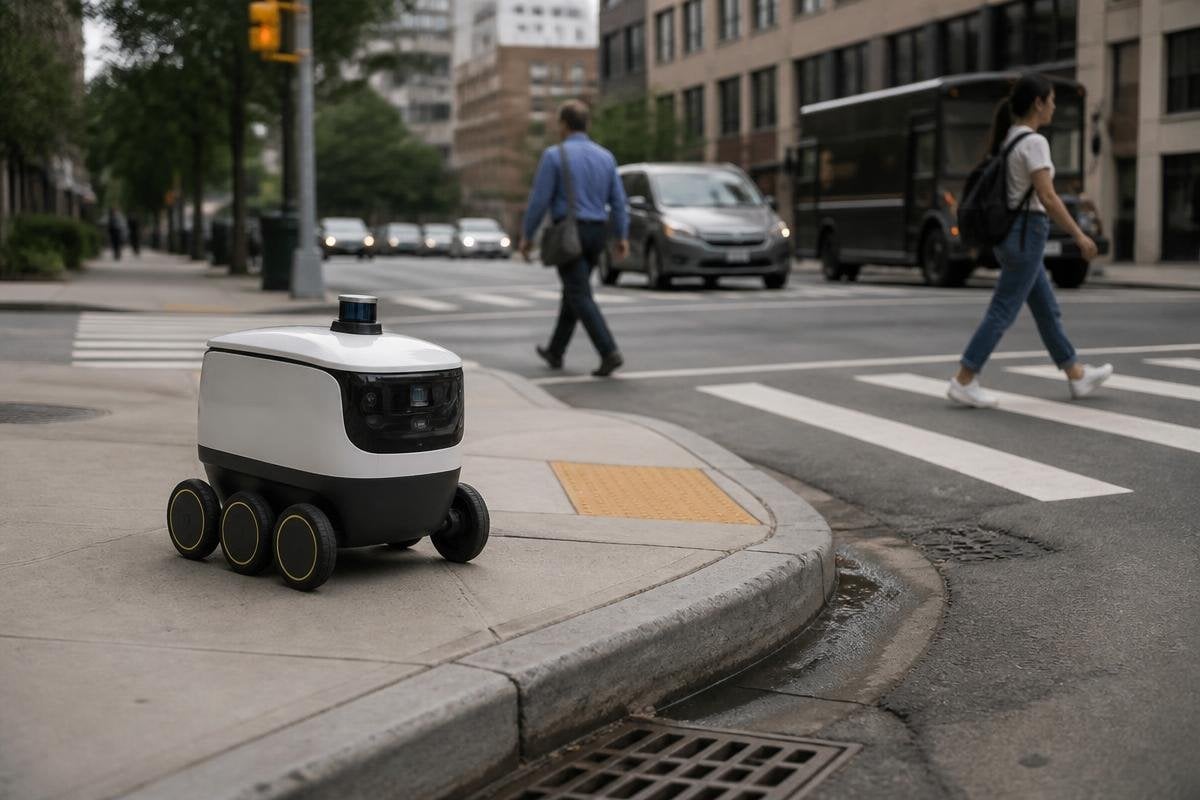
A delivery robot can move well on an empty pavement and still fail at the first blocked curb cut. City streets test the whole system: sensing, route planning, remote support, traffic rules, and the people who share the space.
- Clear paths matter: parked vehicles, bins, roadworks, and crowded corners can stop a route.
- Human help remains part of the system: a remote operator may need to guide the robot around an obstacle.
- Proof must cover failure: a short demo cannot show how the robot handles a full delivery run.
The pavement is the easy part
Sidewalk delivery robots usually use cameras, LiDAR, and wheel sensors to track their position. LiDAR measures nearby objects with laser pulses, while cameras help classify people, signs, vehicles, and surface changes.
That hardware can spot a person in front of the robot. It has a harder job when a delivery van blocks the pavement and leaves a narrow gap beside moving traffic. The robot must decide if the gap is wide enough, wait for a safer route, or ask a remote operator for help.
A curb cut creates another test. If its edge is steep, damaged, or partly blocked, the robot may reach the crossing but fail to line up with the road. A route that looks short on a map can become unusable at one corner.
City traffic creates shared responsibility
A delivery robot on a pavement still affects drivers, cyclists, wheelchair users, and people walking. Its speed, width, stopping distance, lights, and sound all shape how those people react.
Crossings need careful handling. The robot has to detect the road edge, read the crossing signal when one is present, and wait for vehicles that may turn across its path. A camera system can detect a vehicle, but detection alone doesn’t decide who should move first.
Rules also differ by city. Some places may limit where robots can travel, how large they can be, or whether a person must monitor them. Without a named city and a published operating rule, claims about legal operation are not safe to make.
For city delivery robots, Robot24.com’s reporting on street deployments can tie claims to permits, route conditions, and results from named trials. That record matters because the next problem starts when a robot cannot handle a blocked path alone.
Remote operators fill the gaps
Autonomy handles the normal path. Remote support handles the cases the robot cannot classify with enough confidence.
The operator may see the robot’s camera feed, select a safe route around an obstacle, or ask the robot to stop. That person still needs a clear view, a reliable connection, and a rule for when to hand control back to the robot.
This setup changes the cost of a delivery service. A fleet may contain many robots, but one blocked path can still create a human task.
The useful measure is not whether a robot completes a clean route. It is how often people must step in during ordinary city work.
What a useful trial should show
A trial should cover the route that customers will actually use. It should record failed crossings, waiting time, remote interventions, damaged paths, and deliveries that return to the depot.
The trial should also explain what the robot does after a stop. Does it wait in place, move to the side, call for help, or send the order back? Each choice affects pedestrians, staff, and the delivery time.
One smooth video proves very little about a busy street. A useful report names the route, the operating rules, the number of deliveries, and the cases that went wrong.
A buyer’s street check
Before approving a delivery robot route, check these points:
- Map the full path: include curb cuts, crossings, loading areas, narrow pavement, and places where vehicles often stop.
- Set the stop rule: define when the robot waits, pulls aside, or asks a remote operator to help.
- Count human work: record each remote intervention and the time spent on it.
- Test poor conditions: include darkness, rain, surface damage, crowds, and temporary road barriers when the route allows it.
- Publish failures: record blocked paths, late deliveries, returns, and safety stops beside successful trips.
I’d approve a robot for a mapped, low-speed route with clear remote support, but I’d skip any plan that counts only successful deliveries.
The open question is practical: how many human interventions can one operator handle before the delivery robot costs more than a person on the route?